Sourdough Pretzels: Chewy, Salty, Boiled at Home
The short answer: great sourdough pretzels come from a soft, slightly enriched dough, a quick boil in a baking soda bath, and a hot oven. The boil is the step that makes a pretzel taste like a pretzel: it gelatinises the outside of the dough, so the crust bakes up deep mahogany, glossy, and chewy instead of pale and bready. Use active starter for the lightest, puffiest pretzels, or unfed discard for a faster, tangier batch — both work, and this guide covers both paths.
Soft pretzels are one of the best uses of a sourdough starter, because they are fast by sourdough standards. There is no overnight cold proof, no Dutch oven, and no scoring. From mixing to eating takes about three hours with active starter, or under two hours with discard and a pinch of commercial yeast. The dough is forgiving, the shaping is fun, and the result is the kind of snack that disappears while it is still warm — especially with mustard, cheese sauce, or cinnamon sugar.
If you are new to shaping boiled breads, you have already met the closest cousin of the pretzel on this blog: our sourdough bagels use the same boil-then-bake logic, just in a ring shape. Pretzels add one extra skill, the twist, and one extra decision, the bath strength. Get those two right and the rest is easy.
Active starter or discard: which should you use?
Both versions are genuinely good, and the right choice depends on your day, not on snobbery. Active starter, fed and at its peak, gives the best rise and the softest, most open crumb. The pretzels puff in the oven, stay tender for a day, and have a mild, wheaty tang. Use this version when you have a starter ready and a lazy afternoon ahead.
Discard, the unfed starter you would otherwise throw away at feeding time, gives a faster and tangier pretzel. Because discard is less active, this version adds a small amount of commercial yeast (about 1 teaspoon instant yeast) so the dough still rises reliably. The flavour is deeper and more sour, the crumb a little denser, and the whole batch is ready in roughly 90 minutes. If your discard has been sitting in the fridge for a week, it is still fine for pretzels — the boil and the salt mask any sharpness, and the yeast does the lifting. For more ideas that put discard to work instead of in the bin, see our eight discard recipes and our sourdough crackers from discard.
Whichever starter you use, it must smell pleasant — yeasty, milky, or mildly sour. If it smells like nail polish remover, it is hungry, not dead: feed it a few times first, following our guide to a starter that smells like acetone, and bake when it doubles reliably again.
What makes a pretzel taste like a pretzel?
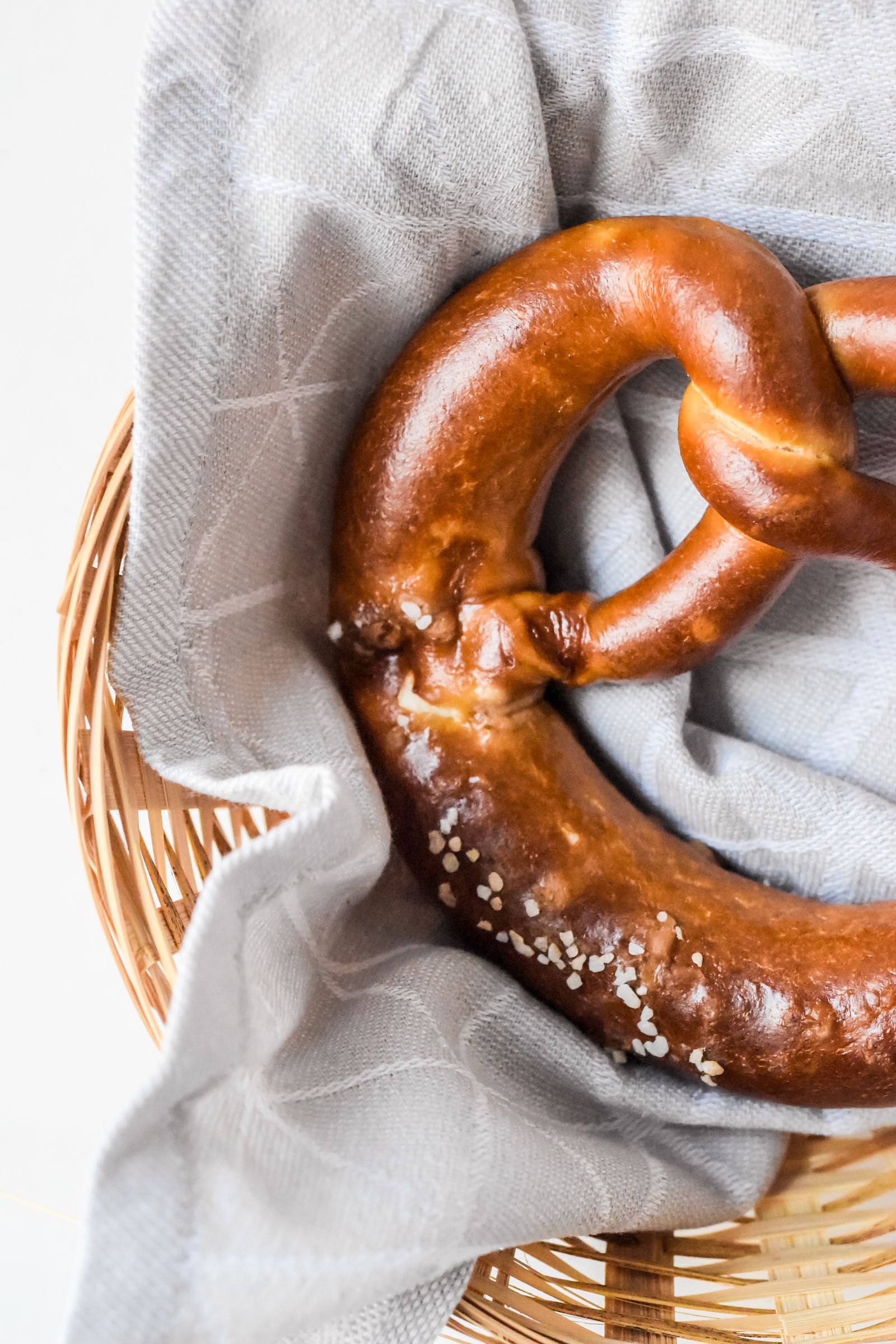
Three things separate a pretzel from a breadstick twisted into a knot. First, the dough is slightly enriched with butter and a little sugar, which keeps the crumb soft rather than crusty. Second, the shaped pretzels are boiled briefly before baking. Third, they are baked hot — 220°C (425°F) — so the boiled skin sets quickly into a chewy, glossy crust.
The bath matters more than the recipe. A baking soda bath (about 60 g, or 1/4 cup, of baking soda per litre of water) is the home-baker standard: safe, easy, and it produces a good colour and a mild pretzel flavour. A food-grade lye bath gives the darkest, glossiest, most authentically Bavarian crust, but lye is caustic and demands gloves and eye protection, so this guide uses baking soda throughout. Do not skip the bath, and do not substitute plain water: without the alkaline dip, you will get soft bread twists, not pretzels.
Ingredients and equipment
For 8 large pretzels you will need: 500 g (about 4 cups) bread flour, 100 g (about 1/2 cup) active starter or 200 g (about 3/4 cup) unfed discard plus 1 teaspoon instant yeast, 300 g (about 1 1/4 cups) warm water or milk, 30 g (about 2 tablespoons) melted butter, 20 g (about 1 tablespoon) sugar or honey, 10 g (about 1 3/4 teaspoons) fine salt, and coarse pretzel salt or flaky sea salt for topping. Milk makes a softer, richer pretzel; water makes a slightly chewier one. Both are correct.
Equipment is minimal: a large bowl, a baking sheet lined with parchment, a slotted spoon or spider strainer, and a large pot for the bath. A stand mixer helps but is not required — this is a soft dough that kneads easily by hand in about 8 minutes. If your kitchen is cold and doughs are slow to rise, our cold-kitchen baking adjustments explain how to keep fermentation moving.
Step by step: sourdough pretzels
1. Mix and knead
Stir the starter (or discard plus yeast) into the warm water or milk until it loosens. Add the flour, sugar, and melted butter, and mix until no dry flour remains. Rest for 20 minutes, then add the salt with a splash of water and knead until the dough is smooth, soft, and slightly tacky — about 8 minutes by hand or 5 minutes on low-medium in a stand mixer. The dough should clear the sides of the bowl but still stick a little to the bottom. If it feels stiff, add water a tablespoon at a time; pretzel dough should be softer than loaf dough, because a stiff dough tears when you roll it into ropes.
2. First rise
Cover the bowl and let the dough rise until roughly doubled. With active starter at a warm room temperature (24–26°C), expect 2 to 3 hours, with one gentle fold halfway through. With discard plus yeast, expect 60 to 90 minutes. The dough is ready when it looks puffy and a gentle poke springs back slowly. If your schedule needs more flexibility, you can refrigerate the dough after this rise and shape it the next day — cold dough is actually easier to roll. Our three baking timelines show how to fit a ferment around work or school.
3. Divide and shape
Turn the dough onto a clean, unfloured surface — a little friction helps you roll ropes — and divide it into 8 equal pieces (about 110 g each). Roll each piece into a rope about 60 cm (24 inches) long, thicker in the middle and tapering toward the ends. If a rope keeps springing back, let it rest for 5 minutes and try again; rested dough stretches much further than fought dough.
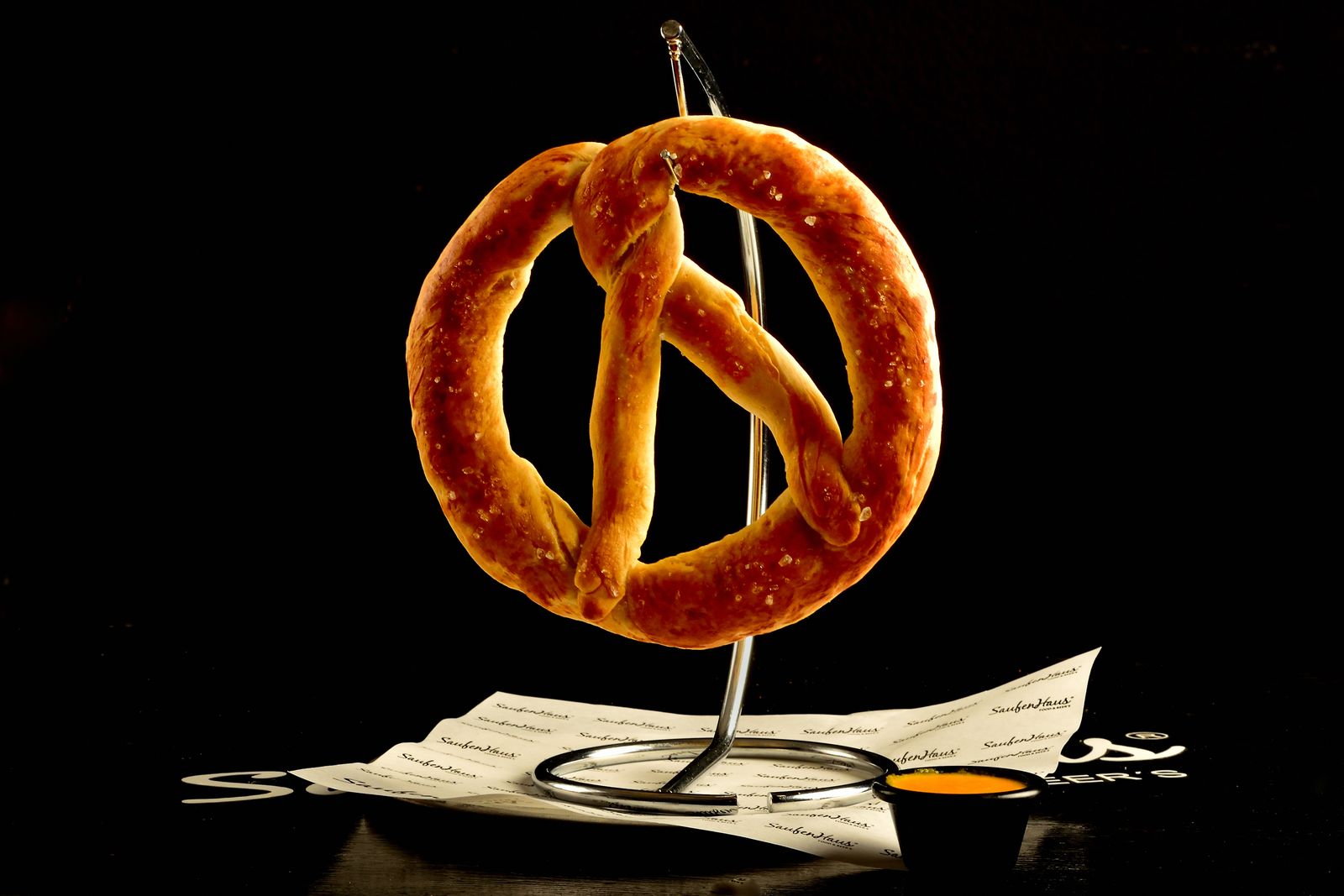
To form the classic shape, lay the rope in a U, cross the ends over each other twice to make a twist, then fold the twisted section down and press the ends onto the belly of the U at roughly the 4 o'clock and 8 o'clock positions. Pinch firmly so the ends stay put in the bath. Do not worry about perfection: slightly wonky pretzels taste exactly like neat ones, and the twist tightens up in the oven. For a simpler option, shape the rope into a bite-size nugget batch instead — cut each rope into 8 pieces for pretzel bites, which boil and bake faster and are ideal for parties.
4. The baking soda bath
Bring a large pot of water to a gentle boil and stir in the baking soda — add it slowly, because it fizzes. Keep the water at a steady simmer, not a rolling boil, which can tear the pretzels. Lower each pretzel in with a slotted spoon, boil for 30 seconds per side (60 seconds total for large pretzels, 30 seconds total for bites), then lift out, let it drip, and place it on the parchment-lined sheet. The pretzels will look pale and slightly wrinkled; that is normal, and the colour comes in the oven.
Two warnings. First, baking soda baths can boil over when the soda goes in, so use a pot much larger than you think you need and add the soda off the heat, stirring until the fizz settles before returning it to the burner. Second, do not use an aluminium pot: the alkaline bath discolours aluminium and can give the pretzels a metallic taste. Stainless steel or enamelled pots are safe.
5. Salt and bake
While the pretzels are still damp, sprinkle generously with coarse pretzel salt or flaky sea salt. Fine table salt dissolves and disappears, so use something coarse. If you prefer, brush with a beaten egg for extra shine, though the bath alone gives a good gloss. Bake at 220°C (425°F) for 14 to 18 minutes for large pretzels, or 10 to 12 minutes for bites, until deep golden brown — darker than you think. Pretzels should be mahogany, not pale gold; pull them too early and the crust stays soft and bready instead of chewy.
Flavour variations
Once the classic is in your repertoire, the same dough takes many toppings. Cinnamon sugar (toss warm pretzels in melted butter, then cinnamon sugar) is the sweet favourite. Garlic Parmesan — butter, garlic powder, and grated Parmesan brushed on after baking — is the savoury one. Everything-bagel seasoning, sesame seeds, or a cheddar-and-jalapeño topping all work; add seeds and cheese before baking, and butter-based toppings after. For dipping, warm cheese sauce, spicy mustard, and beer cheese are the classics, in that order.
Troubleshooting sourdough pretzels
Pale, soft crust. The bath was too weak, the boil too short, or the oven too cool. Use the full 60 g of baking soda per litre, boil the full 60 seconds, and bake until genuinely dark golden. An oven thermometer helps here: many home ovens run 10–15°C cooler than the dial says.
Pretzels lost their shape. The ends were not pinched firmly enough, or the dough over-proofed before shaping and went slack. Pinch the ends into the belly with conviction, and shape while the dough is puffy but not collapsing. If the shaped pretzels spread flat on the tray, chill them for 20 minutes before the bath — cold dough holds its twist better.
Dense, heavy crumb. Usually under-fermentation. The dough should roughly double before shaping, and the shaped pretzels should look puffy, not tight, when they go into the bath. If your starter is sluggish, check our guide to a starter that is not rising before your next batch, and remember that a cold kitchen can double rising times.
Soggy bottoms. The pretzels sat too long on the tray after boiling, or the sheet was not lined. Parchment is essential — boiled dough sticks to bare metal. A light dusting of cornmeal on the parchment helps too, and a wire rack for cooling stops steam from softening the base.
Too salty, or salt disappeared. Coarse pretzel salt is the answer to both problems. Fine salt dissolves into the damp crust and tastes harsh in patches; coarse salt stays crunchy and distributes evenly. If you only have flaky sea salt, it works well, but use a lighter hand than you would with chunky pretzel salt.
Storing and reheating
Soft pretzels are at their best within 4 hours of baking. After that, the crust softens and the crumb firms up. Store leftovers in an airtight bag at room temperature for up to 2 days, and reheat in a 180°C (350°F) oven for 5 minutes to crisp the crust again. For longer storage, freeze baked pretzels in a zip-top bag for up to a month and reheat straight from frozen at 180°C (350°F) for 10 to 12 minutes. You can also freeze shaped, unbaked pretzels after the bath: freeze them on a tray, bag them, and bake from frozen, adding 3 to 4 minutes to the bake time. If you want a more general storage system for everything you bake, our guide to bread bags and storage covers bags, boxes, and freezing in detail.
Frequently asked questions
Can I make sourdough pretzels without commercial yeast?
Yes, if you use active starter at its peak and give the dough a full rise of 2 to 3 hours. The yeast is only needed for the fast discard version, where the starter is too sleepy to lift the dough on its own. A long, cool ferment with active starter gives the best flavour of all.
Is a lye bath better than baking soda?
Lye gives a darker, glossier crust and a more traditional flavour, but it is caustic and requires gloves, eye protection, and careful handling. For home baking, a strong baking soda bath gets you about 85 percent of the way there with none of the risk, and most tasters cannot tell the difference once salt and toppings are on.
Why did my pretzels taste soapy?
Too much baking soda in the bath, or pretzels left in the bath too long. Stick to 60 g per litre and 30 seconds per side. A soapy taste can also come from reusing a bath that has been boiled down and concentrated — make a fresh bath for each batch.
Can I make pretzel bites instead of full pretzels?
Absolutely. Cut each rope into bite-size pieces, boil for 30 seconds total, and bake for 10 to 12 minutes. Bites are more forgiving than full pretzels, they freeze beautifully, and they are the best version for parties and lunchboxes.
Do I need a stand mixer?
No. Pretzel dough is soft and kneads easily by hand in about 8 minutes. A mixer saves effort, but hand-kneading gives you a better feel for when the dough is smooth and ready.
Once you have pretzels down, the same boiled-dough confidence opens up bagels, and the same soft enriched dough logic carries into our sourdough English muffins and sourdough cinnamon rolls. Bake a batch this weekend, salt them generously, and eat at least one while it is still warm — that is the whole point.


Comments
Post a Comment
Play nice — spam and promo links are deleted.